As a professional working with textile dye dispersants and sodium lignosulfonate formulations, I have seen how a small change in dispersant selection can affect milling, filtration, heat stability, storage, and final shade consistency. In this article, I want to explain what a dispersing agent does in textile production, why disperse dyes need it, how the main dispersant types differ, and what buyers should test before making a decision. I will also discuss where sodium lignosulfonate performs well, where it may not be the right choice, and how Jiefa’s ES-3, ES-5, and ES-7 grades are positioned for different dye formulations.
Why Disperse Dyes Need a Dispersing Agent
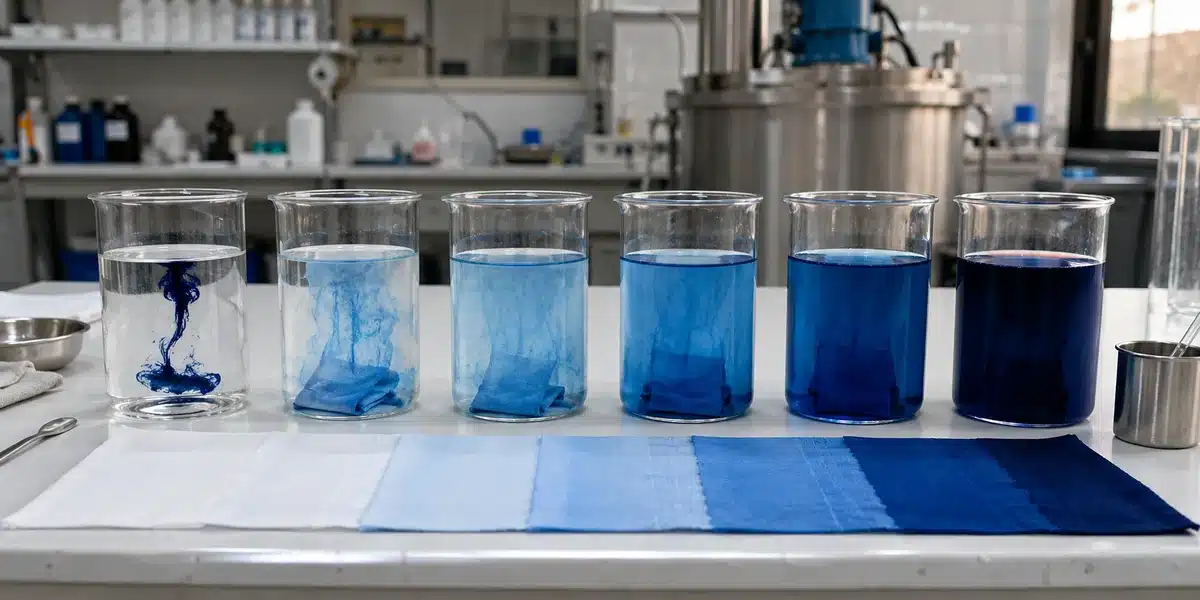
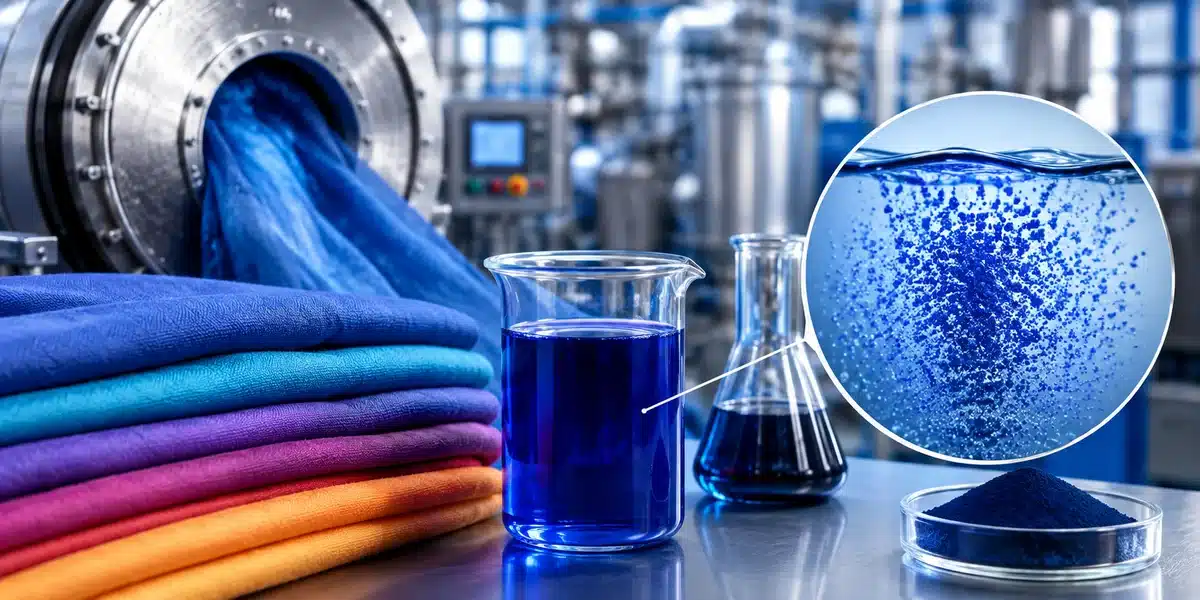
Some textile dyes dissolve readily in water. Disperse dyes behave differently. They have very low water solubility, so most of the colorant remains in the dye bath as extremely small solid particles.
Left alone, these particles gradually collide and join together. Small clusters become larger ones, and the suspension may begin to settle or filter poorly. The mixture can still look acceptable to the eye while the particle distribution is already changing.
A dispersing agent adsorbs onto the surface of the dye particles and makes it more difficult for them to stick together. Depending on its chemical structure, it may create electrical repulsion, physical separation, or a combination of both.
That explanation sounds simple. Production usually is not.
The dye may be milled, dried, stored, transported, diluted, reheated, pumped through pipes, and circulated in a pressurized dyeing machine. The dispersant must continue working through more than the first few minutes of mixing.
For dye manufacturers, dispersing agents are commonly added during grinding and standardization. They help control particle distribution and maintain the stability of finished dye powders or liquid formulations during storage.
Textile mills may also add dispersing agents directly to the dye bath to help maintain a uniform suspension during heating and dyeing.
These two applications overlap, but they are not identical. A product that performs well during dye grinding is not automatically the best option for every dyeing machine or process condition.
What Poor Dispersion Looks Like in Production
Dispersion problems are not always dramatic. Sometimes the first sign is simply slower filtration. In another factory, operators may notice deposits inside a pipe, sediment in a storage tank, or a small shade difference at the end of a batch.
- Dye spots or uneven color on the fabric
- Sediment in storage tanks or containers
- Slow filtration after heating
- Blocked filters, nozzles, or circulation lines
- Different shades from the same recipe
- Hard deposits that are difficult to redisperse
- Additional washing or corrective dyeing
The difficult part is identifying the real cause.
A production team may blame the dispersant because sediment has appeared, only to discover that the latest dye batch has a broader particle-size distribution. Another plant may test several new dispersants before checking its water hardness. Milling time may also have been shortened to increase production output, with the negative effect only becoming visible after storage.
The dispersing agent matters, but it is only one part of the system.
Why Laboratory Results May Differ from Production
Consider a routine laboratory trial. A disperse dye is milled with a new dispersant, diluted, and tested on the same day. The suspension looks fine, filtration is acceptable, and the shade falls within the expected range.
The production team approves the sample.
A larger batch is then prepared and stored before use. After heating, filtration becomes slower. The first assumption is that the dispersant has poor heat stability, so a stronger grade is tested. The result improves, but the problem does not completely disappear.
Further checking reveals two additional differences between the laboratory and production conditions: the factory water is harder, and the large batch receives less effective milling energy per kilogram.
Changing only the dispersant would never have solved everything.
This kind of trial is more useful than a perfect success story because it shows why testing should include the actual water, storage period, temperature, milling equipment, and dye formulation used by the customer.
From an engineering perspective, a dispersant should be evaluated under conditions that resemble real production, not only in a fresh room-temperature sample.
Main Types of Textile Dispersing Agents
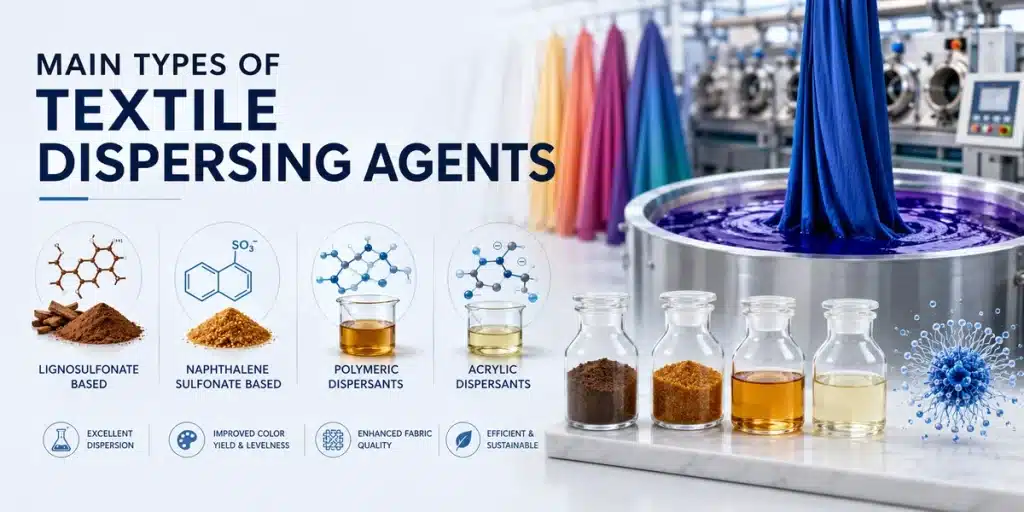
There is no single dispersant chemistry suitable for every dye, machine, and performance requirement.
Dispersant type | Where it is often used | What buyers should check |
Sodium lignosulfonate | Disperse and vat dye formulations | Heat stability, shade influence, grinding performance, and batch consistency |
Naphthalene sulfonate condensate | Conventional dye systems | Dispersion strength, compatibility, and environmental requirements |
Polymeric dispersant | Demanding or specialty formulations | Performance improvement compared with the higher cost |
Acrylic dispersant | Selected dye and pigment systems | pH range, electrolyte tolerance, and compatibility with other additives |
Sodium lignosulfonate is often selected because it offers a practical balance of dispersion, high-temperature performance, availability, and cost. Its lignin-based origin is also attractive to manufacturers looking for more renewable raw-material options.
Still, it is not suitable for every formulation.
Some very bright shades, highly purified dye products, or applications with strict color limits may require a different dispersant or a blended system. A product can provide excellent dispersion while contributing more color than the formulator is willing to accept.
The complete formulation decides—not the product brochure.
Heat Stability Is Important, but It Is Not Everything
Heat stability matters because polyester dyeing is commonly carried out under high-temperature conditions. If the dispersant begins to lose effectiveness during heating, the dye particles may agglomerate before or during dye uptake.
However, heat resistance alone does not describe the complete performance of a dispersing agent.
- Grinding efficiency
- Storage stability
- Filtration behavior
- Foam generation
- Electrolyte tolerance
- Compatibility with other auxiliaries
- Influence on shade and color strength
- Batch-to-batch consistency
One product may perform well at elevated temperature but create excessive foam during mixing. Another may provide excellent initial dispersion but form sediment after several weeks of storage. A third may work well with one disperse dye structure and poorly with another.
Personally, I would be cautious about selecting a dispersant from a single laboratory result. A small evaluation program using the customer’s real dye, water, process temperature, and storage conditions is usually more useful than a long technical data sheet.
How Jiefa’s ES Grades Differ
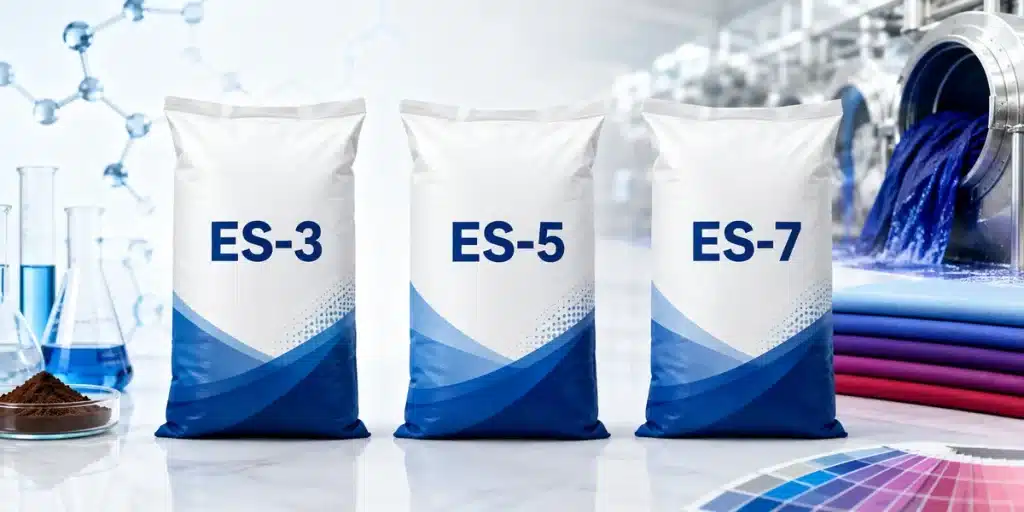
Jiefa supplies several sodium lignosulfonate dye dispersants for different formulation requirements. The grades should not simply be understood as basic, medium, and premium products. Each one should be matched to the customer’s dye system and production conditions.
Grade | Practical positioning | Heat stability | Typical reason to evaluate it |
Higher-performance grade | 155°C | Demanding high-temperature dispersion and stronger stability requirements | |
Balanced performance and cost | 150°C | General disperse dye formulations requiring good milling and manageable viscosity | |
Cost-focused formulation option | 150°C | Applications where formulation economy and oligomer-related performance are important |
ES-7 is generally considered where high-temperature performance is the main concern. ES-5 offers a broader balance between technical performance and cost, making it suitable for many routine commercial formulations. ES-3 can be evaluated where cost control is important and the customer does not require the highest dispersibility grade.
This table is only a starting point.
A customer may assume that ES-7 is automatically the best choice because it has the highest performance positioning. During formulation trials, however, ES-5 may already provide sufficient stability at a lower total cost. In another dye system, the difference between the two grades may only become visible after heating, filtration, or extended storage.
The most expensive grade is not always the most appropriate one.
What Should Buyers Test Before Purchasing?
Many buyers ask about dispersing power first. That is understandable, but one result cannot describe how the product will behave throughout production.
A more useful evaluation includes several stages.
Test item | What it can reveal |
Initial dispersion | Whether particles separate easily after mixing |
Grinding test | Effect on milling time and particle-size reduction |
Heat test | Whether agglomeration occurs at process temperature |
Filtration test | Formation of larger particles or deposits |
Storage test | Sedimentation and redispersibility after standing |
Shade comparison | Influence on color strength or tone |
Foam observation | Possible problems during mixing and circulation |
Testing should use the customer’s own dye whenever possible. Different disperse dyes do not respond identically to the same dispersant.
Dosage also needs attention. A cheaper product used at a higher dosage may cost more in the final formulation. On the other hand, adding too much of a high-performance dispersant does not necessarily improve the result. Excess dosage may influence foam, viscosity, color yield, or compatibility with other auxiliaries.
From a formulation perspective, the useful question is not:
“Which product has the strongest specification?”
It is:
“Which product provides stable production at a reasonable total cost?”
Why Lignin-Based Dispersants Are Receiving More Attention
Textile and dyestuff manufacturers are under growing pressure to reduce dependence on fossil-derived chemicals and improve the environmental profile of their formulations.
This has increased interest in lignin-based dispersants.
Lignin is a natural polymer found in wood. Through pulping and subsequent chemical processing, lignin-based materials can be converted into water-soluble dispersants for industrial formulations.
The renewable origin is valuable, but factories do not continue using a product only because it sounds sustainable. It must still meet practical requirements, including stable batches, manageable foam, reliable filtration, suitable heat resistance, and consistent supply.
This is where some environmental marketing becomes unhelpful. Calling a chemical “green” does not tell a dye manufacturer whether it will remain stable during high-temperature processing or after several weeks of storage.
Technical data and application trials still decide the purchase.
The Dispersant May Not Be the Real Problem
Before rejecting a dispersing agent, it is worth checking whether something else changed:
- Was a different dye batch introduced?
- Did the water hardness increase?
- Was the milling time shortened?
- Did the pH move outside the normal range?
- Was another auxiliary added earlier than usual?
- Is the circulation system working properly?
- Was the laboratory sample tested immediately while the production batch was stored?
Small changes are easy to miss, particularly when several departments and suppliers are involved. The dye supplier may focus on the colorant, the chemical supplier on the formulation, and the factory on the equipment. Each side sees only part of the problem.
Good technical support means separating these factors rather than immediately recommending a stronger or more expensive product.
Final Thoughts
A dispersing agent in textile processing keeps insoluble dye particles under control during grinding, storage, dilution, heating, and dyeing. When it performs properly, operators may barely notice it. When it fails, the effects can appear almost anywhere in the production process.
Sodium lignosulfonate is a practical option for many disperse dye formulations, particularly where manufacturers need a balance of heat stability, dispersion, cost, and renewable raw-material content. Jiefa’s ES-3, ES-5, and ES-7 grades offer different performance characteristics, but product selection should always begin with the customer’s actual dye, water quality, equipment, and processing conditions.
A good dispersant cannot rescue a poorly controlled process. It makes a well-designed process more reliable.