

ES-3 Sodium Lignosulfonate Dye Dispersant
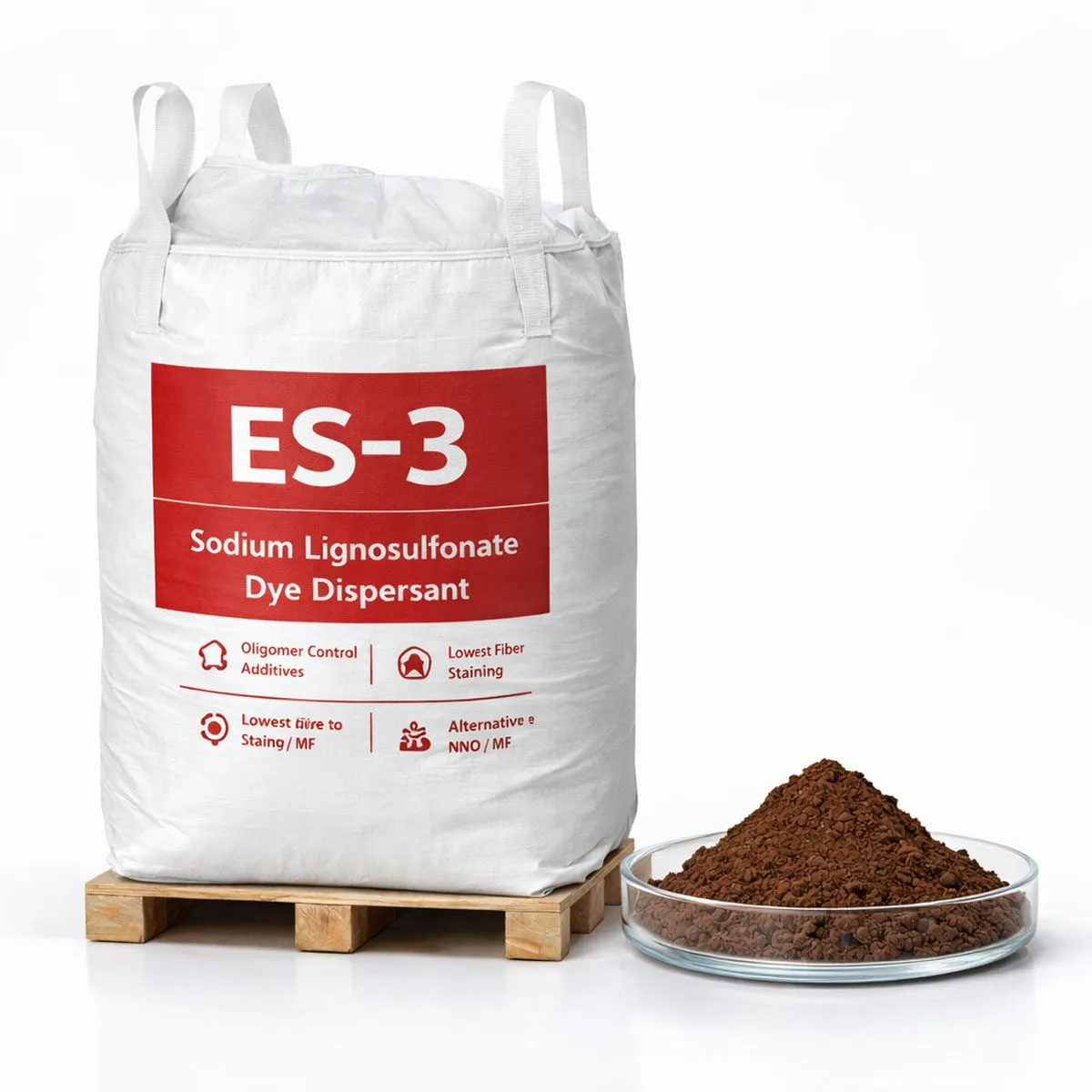
ES-3 Sodium Lignosulfonate Dye Dispersant
- Appearance
- Uniform Brownish Powder
- pH (1% solution, 25°C)
- 9.5–11.0
- Water Content
- ≤10%
- Water-Insoluble Matter
- ≤0.05%
- Heat Stability
- ≥150°C
- High-Temperature Dispersibility
- A / 3–4
Product Overview
ES-3 is the cost-effective grade of the Jiefa ES series. It directly replaces naphthalene-based dispersants (NNO) and MF, and is strong exactly where NNO falls short at HTHP temperature: tar dispersion and oligomer dispersion. Press-cake tar is solubilized, emulsified and encapsulated in dispersant micelles and stays dispersed in the bath, so no free tar separates in HTHP dyeing; oligomers released from polyester stay suspended. The defects they cause disappear — far fewer dye specks, dye blotches and tar stains, a cleaner fabric surface, less machine cleaning and fewer complaints. One dispersant handles tar and oligomers with no extra oligomer-control agent, for a lower total cost in use. ES-3 contains no naphthalene ring structure and is biodegradable.
Challenges in Dyeing Process
- Naphthalene-based dispersants (NNO) have little capacity to solubilize tar and, with heat stability below 110 °C, desorb at HTHP dyeing temperature — tar is released and dyes are left unprotected against oligomers
- Press-cake tar separates as free oil in HTHP dyeing, causing dye specks, dye blotches and tar stains — and complaints — worst in package and warp beam dyeing
- Oligomers accelerate thermally induced aggregation of sensitive dyes, leave white frost on fabric and deposit on vessel walls, nozzles, filters and heat exchangers
- Naphthalene-based dispersants carry the naphthalene ring structure and degrade poorly
Textile Dyestuff Industry
How ES-3 Solves These Problems
- Direct replacement for naphthalene-based dispersants (NNO) and MF at a similar dosage, with no change to the milling process
- Tar dispersion: solubilizes, emulsifies and encapsulates press-cake tar in dispersant micelles, keeping it dispersed — no free tar separates in HTHP dyeing, so tar stains do not form
- Oligomer dispersion: colloidal protection for disperse dyes, inhibited dye crystal growth, oligomers kept suspended and drained away
- Far fewer dye specks, dye blotches and tar stains; no white frost; fewer deposits and cleaning stops
- One dispersant for tar and oligomers, no extra oligomer-control agent: lower total cost in use; naphthalene-free and biodegradable
Key Benefits
- Tar Dispersion
Tar stays dispersed in micelles through 130 °C; NNO desorbs at HTHP temperature - Oligomer Dispersion
Cleaner fabric, less machine cleaning - Cost-Effective
Replaces NNO for a lower total cost in use - Naphthalene-Free
Biodegradable, no naphthalene ring structure
Applications
- Disperse dye production
- Sensitive dye formulations
- High-temperature dyeing processes
- Applications requiring oligomer control
Specifications
Model | Appearance | pH (1% aqueous solution, 25°C) | Water Content /% | Sulfate Content / % | Water-insoluble matter / % | Heat Stability / °C | High Temperature Dispersibility / Grade |
|---|---|---|---|---|---|---|---|
ES-7 | Uniform Brownish Powder | 9.5–11.0 | ≤8 | ≤2.5 | ≤0.03 | 155 | A/5 |
ES-5 | Uniform Brownish Powder | 9.5–11.0 | ≤10 | ≤2.5 | ≤0.03 | 150 | A/4-5 |
ES-3 | Uniform Brownish Powder | 9.5–11.0 | ≤10 | ≤2.5 | ≤0.05 | 150 | A/3-4 |
Get a Quick Response Within 24 Hours
- Professional technical support from experienced engineers
- Customized solutions based on your application needs
- Free samples available for testing
- Direct factory pricing with stable supply
- All inquiries are strictly confidential
REQUEST INFORMATION