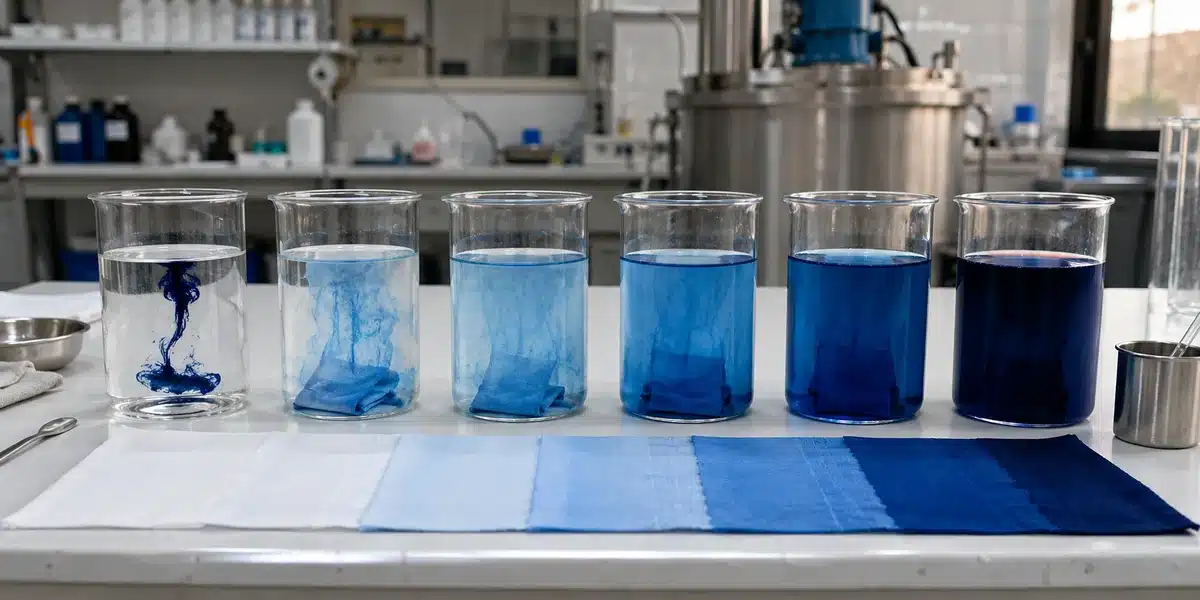
People sometimes ask which dye diffuses the fastest. My first reaction is usually: into what fiber? A disperse dye moving through polyester and a reactive dye entering cotton are not really running the same race.
Still, there is a useful 2026 example. In a study on polyester, the smaller C.I. Disperse Blue 56 showed faster diffusion than the larger C.I. Disperse Blue 148 under the tested conditions. Blue 56 has a molecular weight of about 349 g/mol, compared with about 413 g/mol for Blue 148. The smaller molecule moved into PET more quickly, while the larger dye showed slower, more controlled diffusion and better build-up in some darker shades.
That last part matters. “Fastest” does not automatically mean “best.”
For a dye plant, the useful dye is the one that reaches the required shade consistently without creating leveling, filtration, or processing problems.
What factors affect the diffusion rate of dyes?
If I were troubleshooting slow diffusion in polyester, I would probably look at three things first: temperature, molecular size, and the fiber itself.
Temperature can change the picture dramatically. Polyester is a compact polymer. As it is heated, molecular movement within the amorphous regions increases and dye molecules gain more opportunity to penetrate.
This is why a dye that barely moves into polyester at one temperature may behave quite differently as the process approaches normal high-temperature dyeing conditions.
Molecular size is easier to understand. Smaller molecules usually move through the available spaces in the fiber more readily than larger ones. The Blue 56 and Blue 148 comparison above is a good example.
Then there is the fiber.
Two rolls both labelled “polyester” are not necessarily identical from a dyeing point of view. Crystallinity, previous heat treatment, microfiber structure and manufacturing history can affect how easily dye gets inside.
There are other variables—concentration, pH, electrolytes, water quality and circulation among them—but I would not investigate everything at once.
A more practical troubleshooting table looks like this:
What happened in production? | What I would check early |
Dyeing suddenly takes longer | Actual temperature curve and fiber lot |
Lab sample is good, bulk batch is slow | Heating rate, circulation and water |
Deep shade will not build | Dye size, diffusion time and dye combination |
Color develops too quickly and unevenly | Uptake rate and leveling conditions |
Filtration worsens after heating | Dispersion stability before blaming diffusion |
That last row is important because diffusion and dispersion are often confused.
What additives can improve the diffusion rate of dyes?
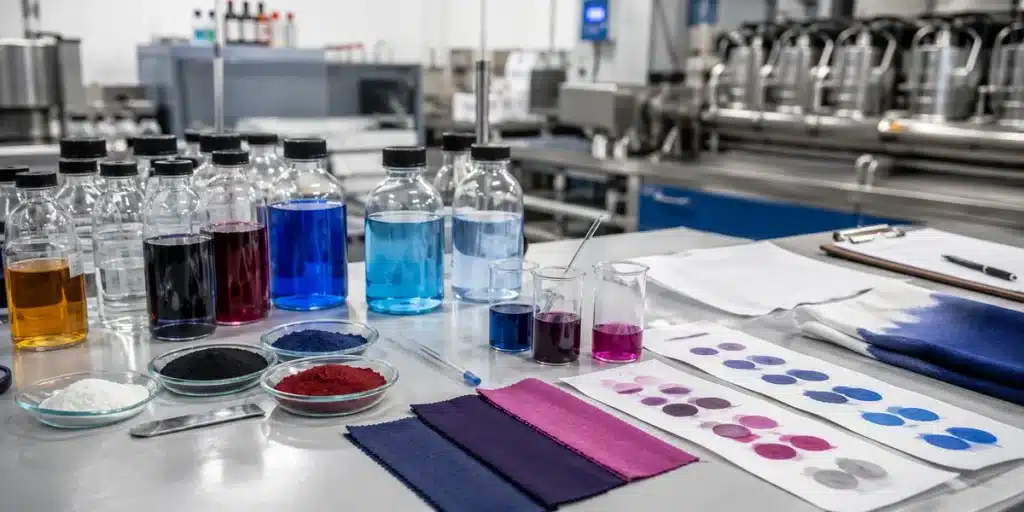
If the question is strictly about helping disperse dyes move into polyester, carriers or dyeing accelerators are one traditional answer.
They can change the local structure or mobility of polyester sufficiently to make dye penetration easier, particularly when working at temperatures below conventional high-temperature polyester dyeing.
A factory capable of controlled high-temperature dyeing may prefer temperature to additional carrier chemistry. Odor, wastewater, cost and compatibility also enter the decision.
There are newer approaches as well. A 2026 study found that a low concentration of an ionic liquid accelerated the overall sorption of C.I. Disperse Blue 56 onto PET. Interestingly, the researchers concluded that the intrinsic diffusion coefficient inside the polyester changed very little; much of the improvement came from increasing dye concentration near the fiber surface.
That is a useful reminder.
An additive can make dyeing look faster overall without literally making each dye molecule travel faster once it is inside the polymer.
Leveling agents may even do the opposite for a reason: they can moderate uptake so that one area of the fabric does not get ahead of another.
Fast dyeing with bad levelness is not much of an achievement.
Is there a relationship between dye dispersants and dye diffusion rate?
Yes, but they are two different parts of the process.
A dispersant mainly deals with what happens before the dye molecule enters the fiber.
Diffusion deals with what happens after molecules begin moving through the fiber structure.
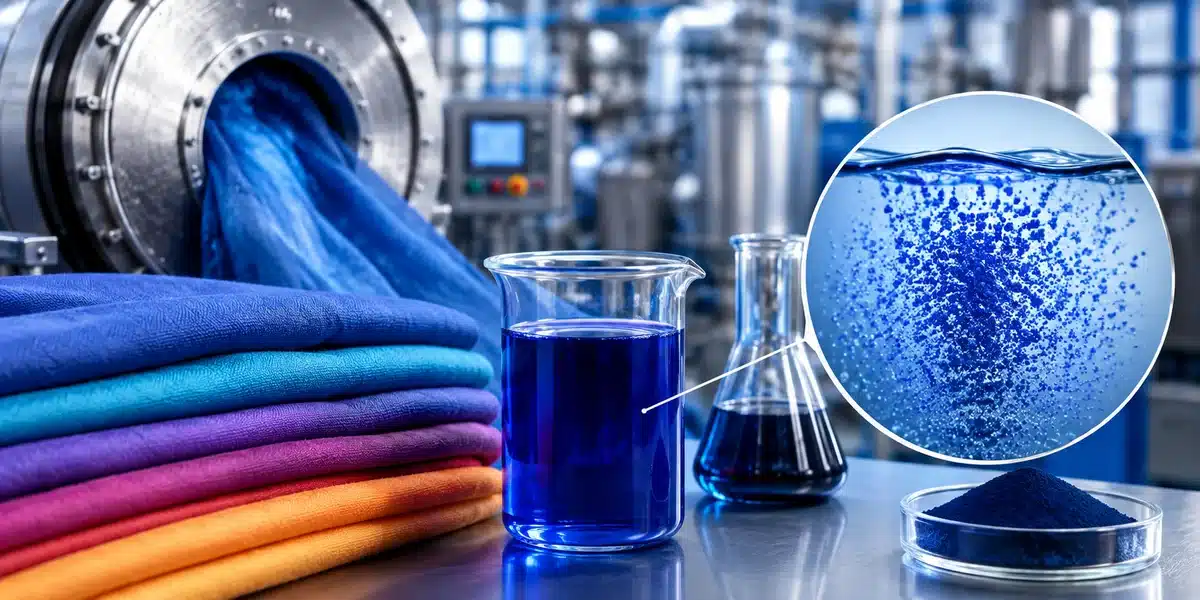
Disperse dyes are poorly soluble in water. In a commercial dye formulation, solid dye particles need to remain finely and consistently distributed. Dispersants such as lignosulfonate-based, naphthalene-based, or polymeric systems help stop those particles from forming larger agglomerates.
Think of a dye bath as having a small dissolved population of dye molecules available to the polyester, while the dispersed particles act as a reservoir.
If that reservoir becomes unstable, the whole supply process becomes less predictable.
A practical trial can make the distinction clear. Imagine replacing an existing dispersant because filtration after heating is poor. With the new dispersant, filtration becomes cleaner and less sediment appears. Yet the time required to reach the target shade barely changes.
Was the trial a failure?
No.
The new product fixed a dispersion problem. It was never necessarily going to change the diffusion coefficient inside polyester.
This distinction matters for Jiefa’s work with sodium lignosulfonate dye dispersants. A customer may need better high-temperature dispersibility, grinding behavior or filtration stability. Those are valid performance improvements even if dye penetration into the fiber remains governed mainly by temperature, molecular structure and the polyester itself.
I would be cautious with any supplier promising that a dispersant will automatically “increase dye diffusion” without first defining what they mean.
Application scenarios of dyes
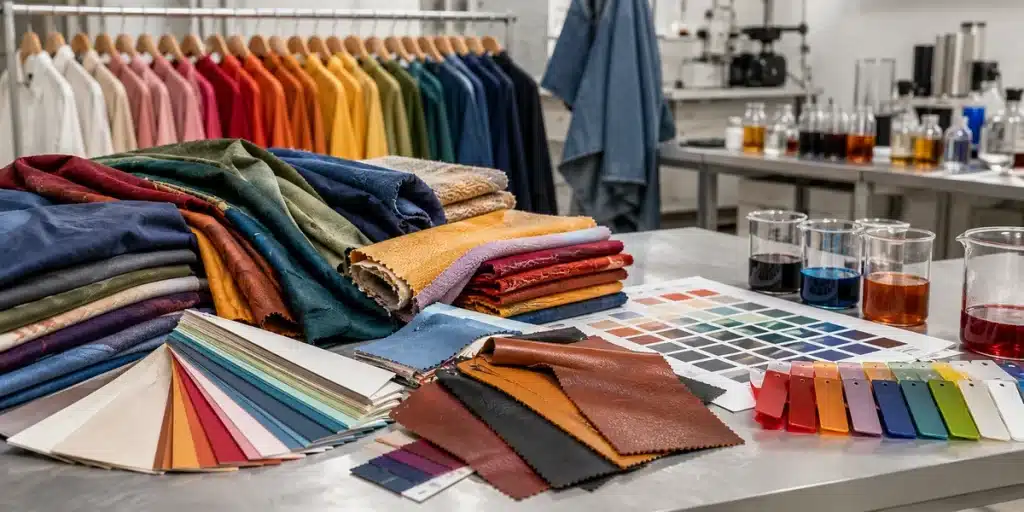
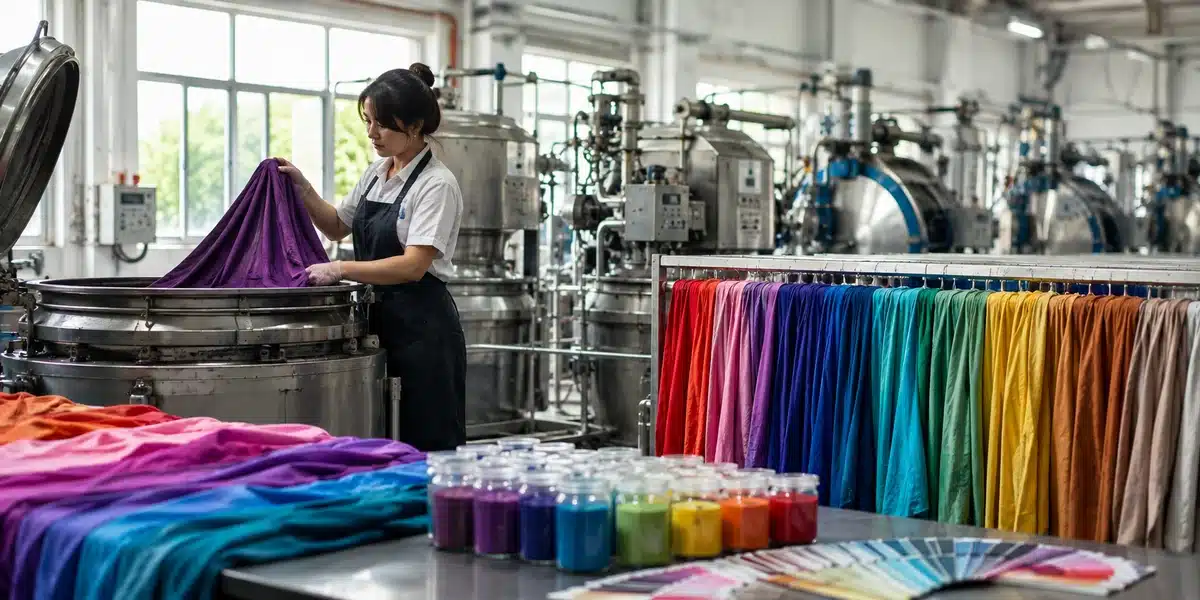
Clothing is the obvious use, but dyes are also found in leather, paper, printing inks and various industrial coloration systems.
The chemistry changes considerably between those applications.
A disperse dye designed to penetrate polyester at elevated temperature tells us very little about how a paper dye should behave. Even within textiles, cotton, polyester, nylon and wool use different dye classes because the fibers themselves are chemically different.
For this discussion, textiles are particularly interesting because dye movement can directly influence cycle time, levelness and final shade.
Sometimes a few minutes of additional diffusion is simply part of the process. Sometimes it becomes a production bottleneck.
In which scenarios is the diffusion rate of dyes most critical?
If I had to choose one obvious case, I would say deep polyester shades.
A pale shade does not require the same quantity of dye to migrate into the fiber. Dark navy, black and other heavy shades leave less room for poor build-up.
But there is a catch.
You want enough diffusion to reach the depth of shade, while still controlling how quickly different dyes are being absorbed. A black recipe may contain several disperse dyes with different molecular sizes and diffusion characteristics. One component getting ahead of the others can influence the developing shade.
Microfiber polyester creates another challenge. Its much larger surface area and different fiber geometry can make dyeing behavior noticeably different from conventional polyester.
Diffusion also matters when factories try to shorten dyeing cycles.
Saving ten minutes sounds attractive until the new process produces uneven shade or incomplete build-up.
Sometimes the old recipe was slow for a reason.
What additives are included in dyes?
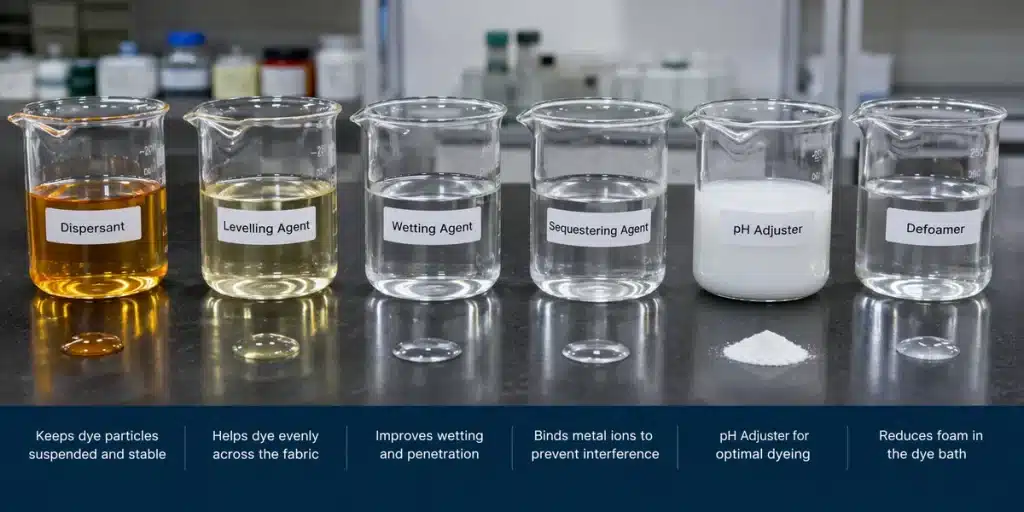
Commercial dye products are rarely nothing but pure colorant.
A formulated disperse dye, for example, may contain dispersant and other formulation components that help the product survive grinding, drying, storage and later redispersion.
Then the dyehouse adds its own auxiliaries.
Depending on the process, these may include leveling agents, wetting agents, pH-control chemicals, sequestering agents, defoamers, carriers and washing chemicals.
Not all of them belong in every recipe.
For disperse dye manufacturers, the dispersant is particularly important because the commercial dye needs to remain usable long before it reaches a piece of polyester.
This is also why evaluating only one specification can be misleading. A dispersant may look excellent in a fresh dispersion test but behave differently after heating. Another may have excellent thermal performance but require a dosage that makes the economics unattractive.
The first sample may fail.
The second may be better.
Occasionally the existing formulation is still the right one.
That is normal formulation work.
When a dye formulation is running properly, the dispersant stays in the background. Filtration behaves as expected, particles stay under control, and the production team moves on to the next batch.
Nobody needs to celebrate it.
That is usually the point.
Related Post might be HELPFUL to you: How to the Dye Clothes in 2026?