What Are Textile Auxiliaries?
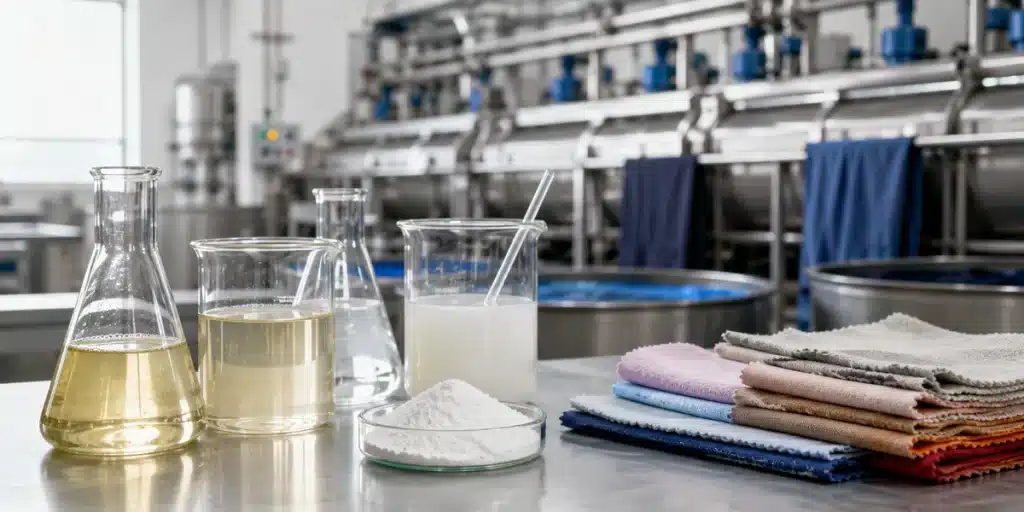
Textile auxiliaries are the chemicals that make textile processing workable. They are used before, during and after dyeing to control things such as wetting, dispersion, foam, leveling, washing and fabric feel. The dye may get most of the attention, but in day-to-day production an auxiliary can easily decide whether a batch runs normally or turns into a troubleshooting job.
At Jiefa, our work is mainly related to dispersing agents rather than the entire textile chemical chain, so we tend to look at auxiliaries from that angle.
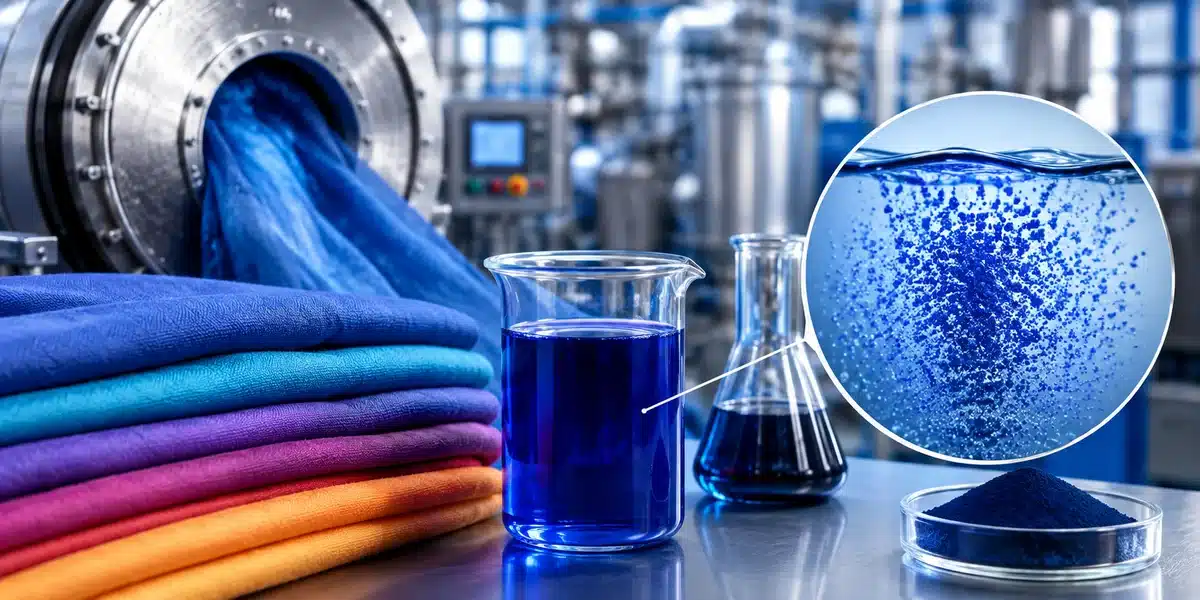
Disperse dyes are a good example. They do not simply dissolve in water and stay there. Fine particles have to remain separated during milling, storage, dilution and heating. If the dispersion starts to break down, filtration may slow, sediment may appear and the shade can become less predictable.
That is not always a dramatic failure. Sometimes the only sign is that a filter that normally takes ten minutes suddenly takes much longer.
A buyer may blame the dispersant immediately. Sometimes that is correct. Sometimes the water changed. Sometimes milling was shortened. Sometimes the new dye batch behaves differently.
Textile chemistry is rarely polite enough to give you only one cause.
Process | Common Auxiliary | Main Purpose |
Pretreatment | Wetting / scouring agent | Help remove oil and impurities |
Dyeing | Dispersing / leveling agent | Keep dye stable and improve shade uniformity |
Printing | Binder / thickener | Control print definition |
Washing | Soaping agent | Remove unfixed color |
Finishing | Softener / repellent | Change feel or add function |
This is also why price per kilogram is not a very useful way to judge an auxiliary on its own.
Suppose one dispersant is cheaper but needs a higher dosage. Another costs more but shortens milling or gives better filtration after heating. On paper, the first product wins. In the factory, maybe not.
A good auxiliary does not need to look impressive.
It needs to behave the same way tomorrow.
10 Best Textile Auxiliary Chemical Manufacturers in the World
There is no serious technical method for ranking every textile auxiliary manufacturer from first to tenth. The market covers everything from dye dispersants to silicone softeners and water repellents, so “best” always depends on the application.
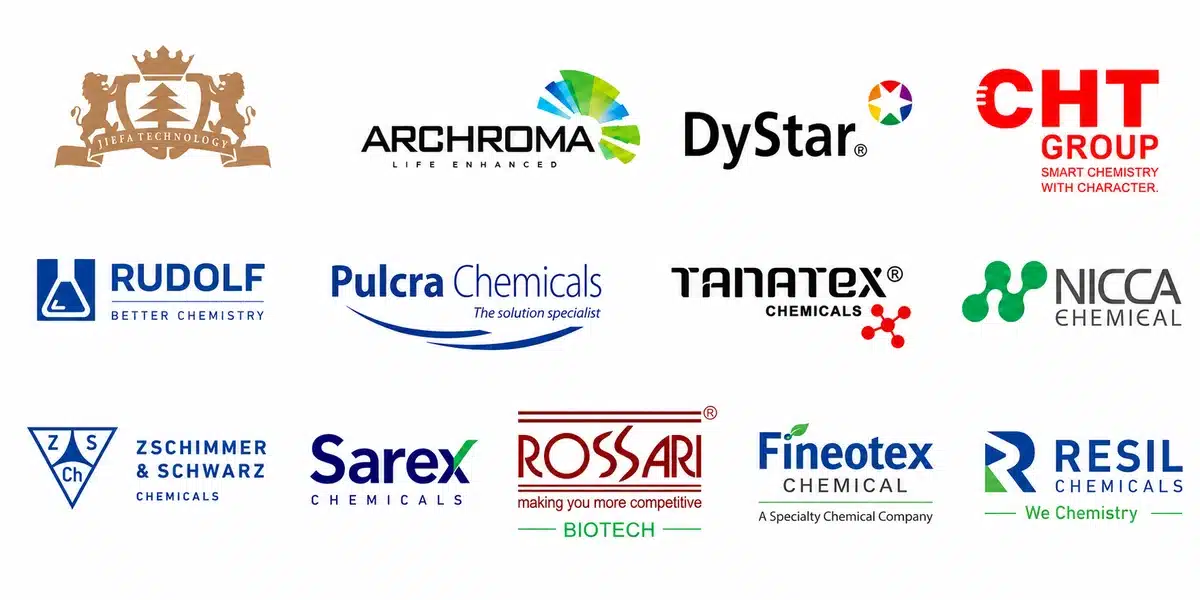
Still, these are ten companies worth knowing when building a supplier shortlist.
1. Jiefa
Zhejiang Jiefa Technology Co., Ltd. is more specialized than most of the companies below.
Its textile-related business is mainly built around lignin-based dispersants, particularly sodium lignosulfonate products used in dye formulations. The ES range includes ES-3, ES-5 and ES-7, with different positions in terms of heat stability, filtration behavior, grinding performance and formulation cost.
That narrow focus has a practical advantage.
A customer with a disperse dye problem does not necessarily need a supplier with 500 textile products. They may simply need somebody who understands what happens to the dispersion during milling, storage and heating.
Jiefa is not trying to be the supplier for every textile auxiliary. If a factory needs enzymes, silicone softeners and finishing chemicals in one order, there are better choices on this list.
For dye dispersion, though, specialization matters.
2. Archroma
Archroma is much broader.
Its textile business covers coloration, pretreatment, printing, finishing and performance chemicals. For large mills operating in several countries, that scale can make purchasing and technical coordination easier.
A global supplier is not automatically the right supplier for a narrow formulation problem, but global support matters when several factories need to use the same chemistry.
3. DyStar
DyStar is interesting because it sits on both sides of the conversation: dyes and textile chemicals.
That makes sense in production. A dispersant cannot really be judged without considering the dye it is working with.
For companies already buying DyStar dyes, testing its auxiliaries is an obvious step. There is less distance between the color problem and the chemical discussion.
4. CHT Group
CHT is one of the established names in textile process chemistry.
Its range covers more than dyeing, and that can be useful when a factory is dealing with a problem that does not fit neatly into one category.
Poor leveling, for example, may not be a leveling-agent problem alone. Temperature, water and other auxiliaries can all be involved.
That kind of troubleshooting is often more useful than simply recommending another product.
5. RUDOLF
RUDOLF is particularly strong in finishing and functional textile chemistry.
If the project is about hand feel, repellency or another finishing effect, RUDOLF may move much higher on the shortlist.
For a basic dye dispersant project, I would look elsewhere first.
That does not make one company better than another. They are solving different problems.
6. Pulcra Chemicals
Pulcra covers a large part of the textile process, from early-stage preparation through dyeing and finishing.
This type of supplier makes sense for mills that want fewer vendors.
There is a practical benefit to that. One purchasing team, fewer technical contacts, fewer qualification procedures.
The downside is equally simple: a specialist can sometimes understand one narrow problem better.
7. TANATEX Chemicals
TANATEX is more associated with specialty textile chemistry than basic commodity auxiliaries.
It is the kind of supplier buyers usually look at when there is a specific performance target rather than a simple “we need a cheaper chemical” request.
That may be unnecessary for a mature, cost-driven process.
For a higher-value textile project, it is a different story.
8. NICCA Chemical
NICCA has a long history in textile processing chemicals and is especially familiar to buyers in Asian manufacturing markets.
Its positioning makes sense for factories where consistency and process control are more important than squeezing a tiny amount out of the chemical cost.
In premium textile production, a small saving can become expensive very quickly if the batch has to be corrected.
9. Zschimmer & Schwarz
Zschimmer & Schwarz works in textile auxiliaries as part of a wider specialty chemical business.
Its textile range includes dyeing, lubrication, aftertreatment and finishing products.
Some buyers like suppliers with this broader industrial chemistry background because textile problems are not always purely “textile” problems. Surface chemistry, lubrication and particle behavior overlap more than the product categories suggest.
10. Sarex
Sarex is an Indian manufacturer with a strong textile auxiliary portfolio.
Its products cover pretreatment, dyeing, printing, finishing and technical textile applications.
For buyers comparing Indian suppliers, Sarex is one of the names that comes up quickly because textile processing is a central part of its business rather than a small side category.
The useful comparison is not really “Who is number one?”
It is closer to this:
If you need… | Look for… |
A dye dispersant | A supplier that understands milling, filtration and heat stability |
Several textile chemicals | A broad full-line supplier |
Functional finishing | A finishing specialist |
Lower sourcing complexity | One supplier covering multiple processing stages |
That is a more practical way to use any top-ten list.
Best Textile Auxiliary Chemical Manufacturers in India
ndia has a large textile manufacturing industry, so there is no shortage of domestic textile chemical suppliers.
Four companies are particularly worth checking at the beginning of a supplier search: Rossari Biotech, Fineotex Chemical, Sarex and Resil Chemicals.
Rossari Biotech
Rossari has a broad specialty chemical business and serves several parts of textile processing.
For a mill buying pretreatment, dyeing and finishing products together, that breadth is useful. It reduces the need to qualify a different supplier for every chemical.
I would look at Rossari first when the requirement is broad rather than highly specialized.
Fineotex Chemical
Fineotex also covers a wide range of textile processing chemicals and works with both domestic and export markets.
Its portfolio makes it relevant to mills that prefer one manufacturer for several stages of wet processing.
The interesting question is not how many products appear in the catalogue, though. It is how well the supplier can support the specific process being used.
Sarex
Sarex is more obviously centered on textiles.
Its range covers pretreatment, dyeing, printing and finishing, so a textile buyer does not have to spend much time working out whether the company understands the industry.
For an Indian textile mill, that focus is a practical advantage.
Resil Chemicals
Resil has a somewhat different profile.
It is especially associated with finishing chemicals, silicone products, lubricants and functional treatments.
If the customer is trying to improve hand feel or add a finishing function, Resil may deserve more attention than a supplier known mainly for dyeing auxiliaries.
For a disperse dye filtration problem, I would build another shortlist.
That distinction is worth keeping in mind because buyers sometimes start with the supplier name and only later define the actual technical problem.
It should probably happen the other way around.
Instead of writing:
“Please send your best dispersant.”
A more useful inquiry would be:
“Our disperse dye filters well before heating, but filtration becomes worse afterwards. We want to reduce cost, but we do not want the shade to change.”
Now there is something technical to discuss.
The supplier can ask about the dye, temperature, dosage, milling time and water. Maybe the dispersant is the issue. Maybe it is only part of the issue.
The first test may still fail.
That is normal.
A useful supplier should be able to explain why, adjust the recommendation, or simply admit that another chemistry may work better.
For textile auxiliaries, that kind of response is often more valuable than a long list of certificates or a very polished brochure.
If the chemical works from batch to batch and the production team stops talking about it, that is usually a good result.
Related Post might be HELPFUL to you: What chemicals are used in textiles?