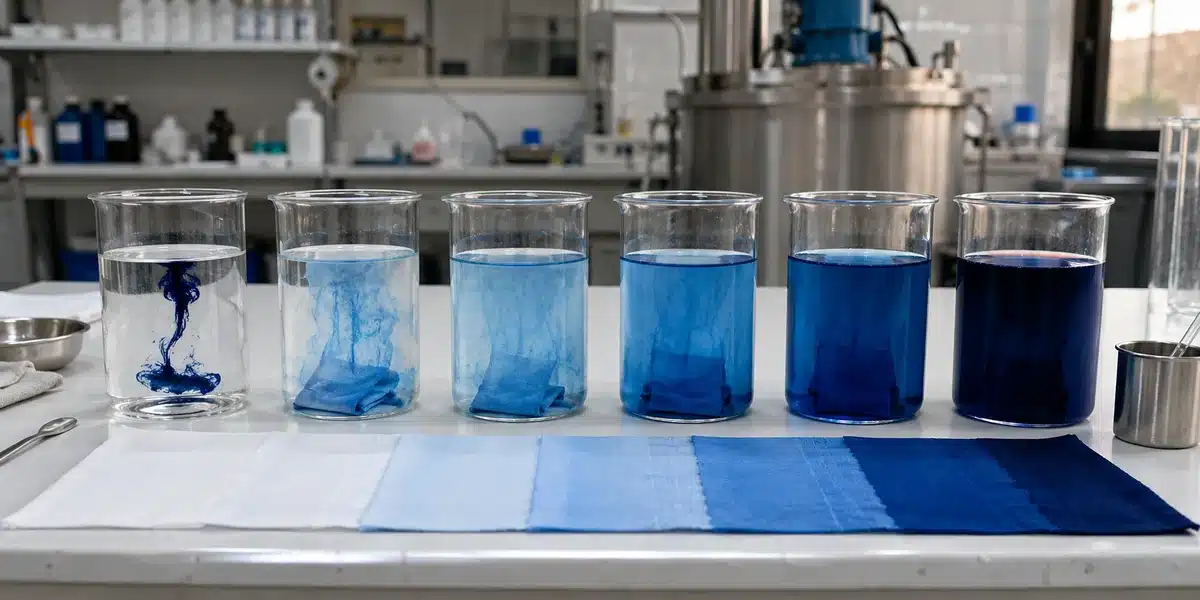
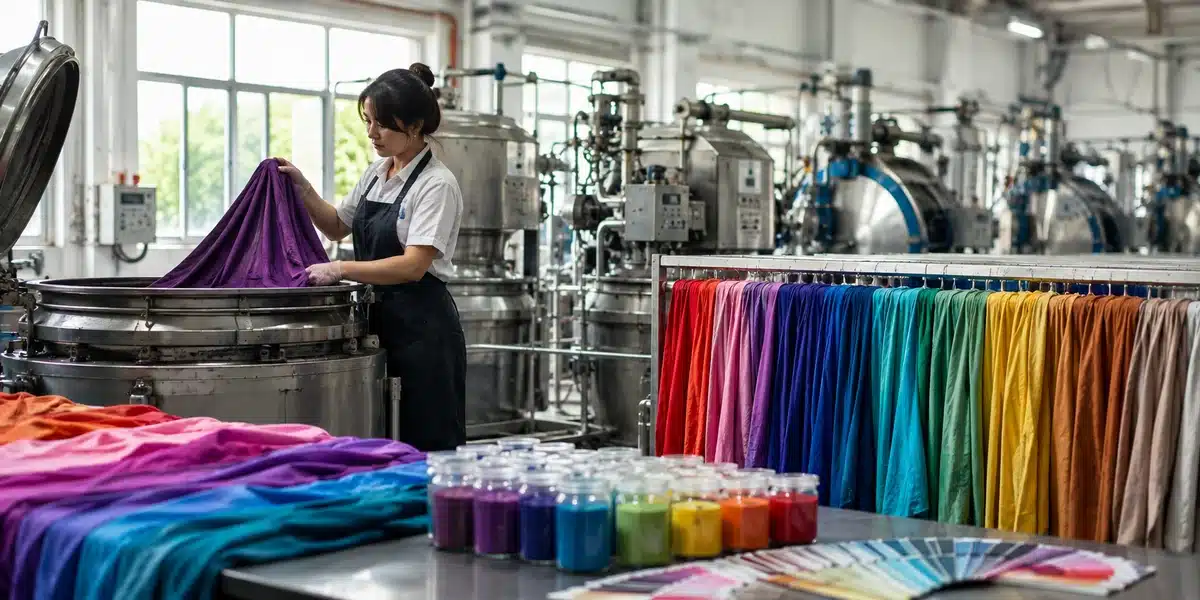
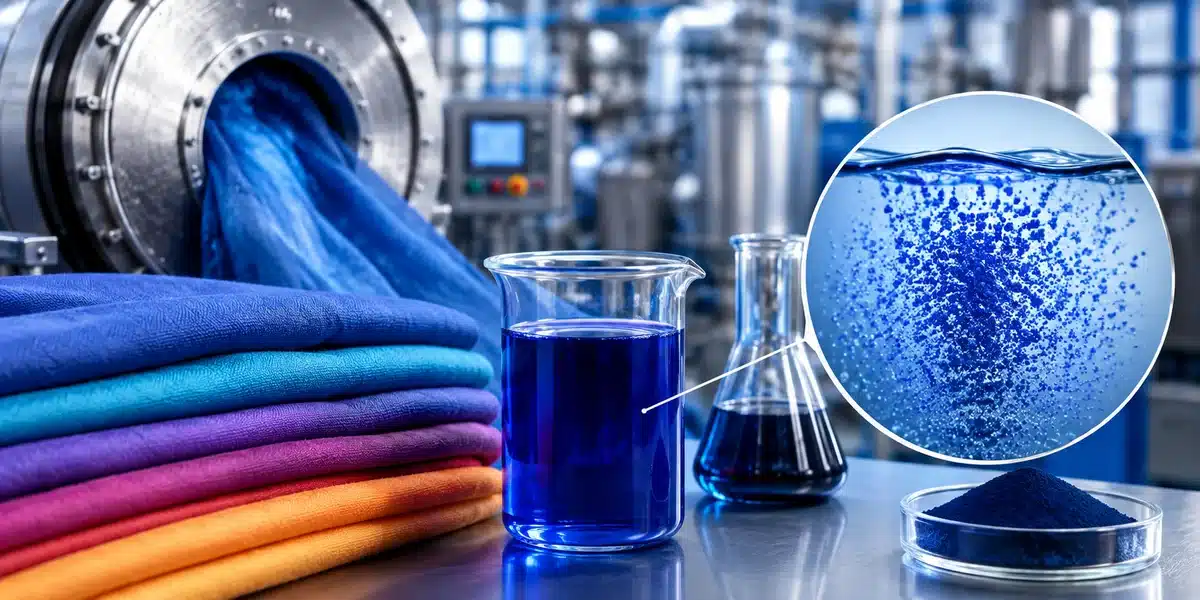
Chemicals are involved in every step of the production process, from raw materials to finished textile products. A serious of chemical processing steps is needed for producing our daily clothing from natural fiber such as cotton or wool, or synthetic fiber such as polyester or nylon.
Understanding the types and industrial use of textile chemicals can provide knowledge for textile factory buyers and chemical raw material supplier, and also provide an important concept for assessment of quality control and environmental impact.
1. Types of Textile Chemicals

Textile chemicals can be categorized by use: Dyes, auxiliaries, finishing agents, and functional chemicals. Each category serves a different purpose in each production process.
Dyes are responsible for giving fabric color, while auxiliaries are dyeing assistants that can make the printing process more even and effective. Finishing agents can improve the softness, appearance, and durability of fabrics. On the other hand, functional chemicals can provide special function to fabric, such as waterproof, flame-retardant, or antibacterial.
The global market of textile chemicals is enormous, with the estimation value of US $26 billion in 2024 and expected to increase to US $34 billion in 2030. The largest consumer market is the Asia-Pacific market, which includes China, India, and Bangladesh, and it accounts for 65% of the global market.
2. Why Chemicals Are Important in Textile Manufacturing?
The modern textile industry cannot work without chemicals. The raw cotton fibers contain natural impurities, fats, and pigments. They must be processed by chemicals before being evenly colored. Due to the strong hydrophobicity, synthetic fibers such as polyester cannot be colored without auxiliaries.
Other than the appearance, chemicals can also affect the functionality and durability of the product. The anti-wrinkle treatment can make clothes iron-free, while a waterproof coating can keep outdoor clothing dry in the rain. Flame retardant can also help industrial safety clothing to meet the regulatory requirements.
The choice of chemicals can also affect the environment and human health. Some traditional textile chemicals contain hazardous materials, such as formaldehyde, heavy metals, and halogenated flame retardants. The demand of green textile chemicals is growing rapidly because of the promotion of International certification standards such as REACH and GOTS.
3. Chemicals Used in Textile Pretreatment
Pretreatment is the preparation process before dyeing. Its main purpose is to remove impurities from fibers to ensure even dyeing. The chemicals include:
Caustic Soda (NaOH): | Used in mercerizing of cotton fibers to enhance fiber luster and dye uptake. After mercerization, the dye uptake of cotton fibers can be increased by more than 30%, which is the standard procedure for high-quality cotton products. |
Hydrogen Peroxide: | The most common bleaching agent that can remove natural pigments without damaging the fibers. It can be used with peroxide stabilizers to ensure even bleaching. After bleaching, peroxide killer should be used to remove the residual hydrogen peroxide completely, otherwise it will interfere with the subsequent dyeing process. |
Enzymes: | The role of enzymes is more and more important in pretreatment because of the breakthroughs in biotechnology. Cellulase can remove the surface hairiness of cotton and smoothen the fabric surface, while Amylase can be used in desizing to remove the sizing agents in the weaving Process. Compared with traditional chemicals treatment, the treatment by enzymes is more environmental friendly, with lower wastewater load. |
Scouring agents: | They are a type of surfactant that can remove natural oils, waxes, and other impurities from the fibers. In the pretreatment of Polyester, scouring agents can also remove the spinning oil. Incomplete scouring leads to uneven dyeing, which is one of the common quality problems in a dyeing factory. |
4. Chemicals Used in Textile Dyeing
Dyeing is the most complicated process in textile production, which has the highest consumption of chemicals. Different fibers require different types of dyes and auxiliaries.
Reactive Dye: | It is generally used for cellulosic fibers such as cotton, linen, and viscose. The dye forms a covalent bond with the fiber, which results in excellent color fastness. Dyeing needs to be performed in an alkaline environment. Soda Ash or Glauber’s Salt will be added as an accelerator. The degree of fixation is around 70-80%, while the remaining 20-30% dye will enter the wastewater system, which makes wastewater treatment one of the biggest challenges to the dyeing factory. |
Disperse Dye: | It is dedicated to synthetic fibers such as polyester and nylon. Because of the strong hydrophobicity,dyeing of synthetic fiber needs the condition of high temperature (over 130°C) or the aid of a carrier. |
Direct Dye: | It is mainly used for cotton fiber. It is easy to use, but the color fastness is poor compared with that of reactive dye, and fixative treatment is required. Besides, it is easily faded after washing, therefore it is now primarily used for low-cost paper dyeing instead of premium garments. |
Acid Dye: | It can be used for protein fibers such as wool and silk. The dyeing has to be carried out in an acidic environment (pH 3-6), and the common auxiliaries include Acetic Acid and Ammonium sulfate. |
5. Chemicals Used in Textile Printing

Textile printing can be understood as “local dyeing”, which precisely prints pigments and patterns in designated locations of the textile. The commonly used chemicals include:
Pigment Binder: | It is the most important auxiliary agent in pigment printing, which fixes the pigment onto the fiber surface. The quality of the binder can affect the print fastness and softness. |
Thickener: | It controls the flowability of the pigment to ensure a clear printing pattern and colorfastness. The commonly seen thickener is Sodium Alginate, which is used for reactive dye printing, while the synthetic thickener is used for pigment printing. |
Resist Agents: | It is used for resist printing. It forms a protective layer on the printing area to prevent the base dye from reacting with the fiber, which results in a clear white or light-colored pattern. |
Urea: | In reactive dye printing, urea functions as a moisturizer, which aids dye dissolution and promotes the fixation reaction. The effect is obvious in a dry environment. In the process of steaming and fixation, urea absorbs water to keep the pigment moist, which ensures the dye and fiber react completely. |
6. Common Surfactants Used in Textile Processing
Surfactants are the most used auxiliary agent in textile chemicals. They almost appear in each production process.
Anionic Surfactant: | It is the most common ingredient in refining agents and detergents, with strong cleaning power and low cost. One of the examples is Sodium dodecylbenzenesulfonate (SDBS). |
Non-ionic Surfactant: | Its performance is stable in the dye bath with high salt concentration, which is not affected by pH value. It is commonly used as a leveling agent and dispersing agent, and one of the examples is Polyethylene Glycol (PEG). |
Amphoteric Surfactant: | It is gentle on the skin and is used for finishing high-end textiles, such as baby clothes and underwear. |
When choosing the type of surfactants, biodegradability is an increasingly important factor. It is banned by the EU to use Nonylphenol Ethoxylates (NPEO) in textile production, because it may break down to Nonylphenol (NP), which is an endocrine-disrupting chemical.
7. What Chemicals Are Used in Polyester Dyeing?

Polyester is the fiber that is consumed the most globally. However, it makes dyeing a major challenge because of its hydrophobicity and compact molecular structure. Therefore, chemicals must be used for dyeing polyester.
Disperse Dye: | It is the only type of dye that can dye polyester effectively. The dye is dispersed in water as extremely fine particles, which penetrate into the polyester molecular chains at high temperatures and being locked in fibers after cooling. |
Dispersing Agent: | It ensures the dye particles are evenly dispersed in the dyebath and prevents particle aggregation. The commonly seen dispersing agent is Sodium Lignosulfonate. |
Carrier: | It is used in atmospheric low-temperature (100°C) dyeing, which can temporarily expand the molecular chains in polyester and allow the entrance of dye. The commonly seen carriers include Benzyl Benzoate and Biphenyl, but their use is limited because of their toxicity. |
Reduction Clearing Agent: | The surface dye after dyeing needs to be removed by a reduction clearing agent. It requires a mixture of Sodium Hydrosulfite and caustic soda at a temperature of 60-80°C. |
pH Regulator: | A slightly acidic environment (pH 4-5) is required in polyester dyeing. Acetic Acid is commonly used to regulate the pH value, which can ensure dye stability and color uniformity. |
8. How to Choose the Right Textile Chemicals
Other than the cost, the choice of textile chemicals depends on the fiber type, production process, environmental requirements, and application.
The main concern is the fiber type. The chemical characteristics of fibers such as cotton,wool, polyester, and nylon are completely different. The choice of dyes and auxiliaries must match the structure of fibers. Using the wrong dye will cause dyeing failure and even damage the fibers.
Some traditional chemicals cannot be used if the product requires certification with OEKO-TEX, GOTS, or REACH. It is necessary to select a compliant alternative, especially for textiles exported to the EU or the US.
The cost of the entire production process has to be considered instead of the unit price of a single chemical when choosing textile chemicals. For example, the unit price of high-efficiency leveling agent is high, but the rework rates and wastewater treatment costs can be reduced, and therefore, the cost of the entire production process is lower.
The working conditions of textile chemicals are very precise. A small difference in temperature, pH value, or concentration may have a huge influence. Choosing a supplier with technical support is more important than simply pursuing the lowest price.
It is recommended to ask the supplier to provide a sample and technical data sheet (TDS) when purchasing textile chemicals for the first time. A pilot production should also be run before mass production. The actual performance of different batches of chemicals may be different even though they have the same specifications. Stable suppliers and batch consistency are essential for mass production.