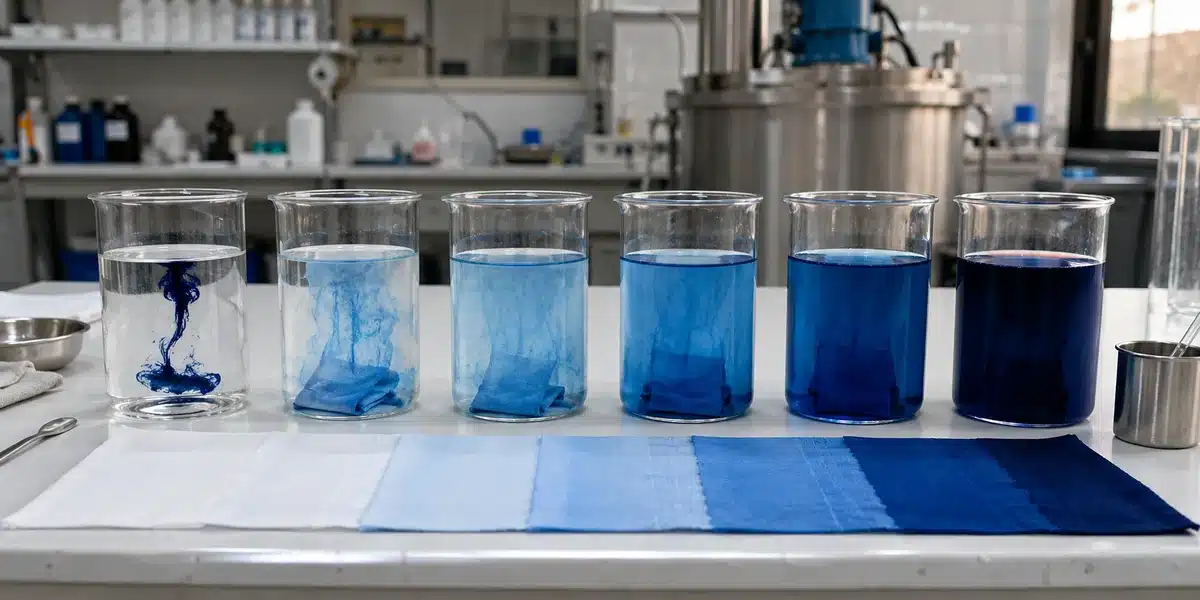
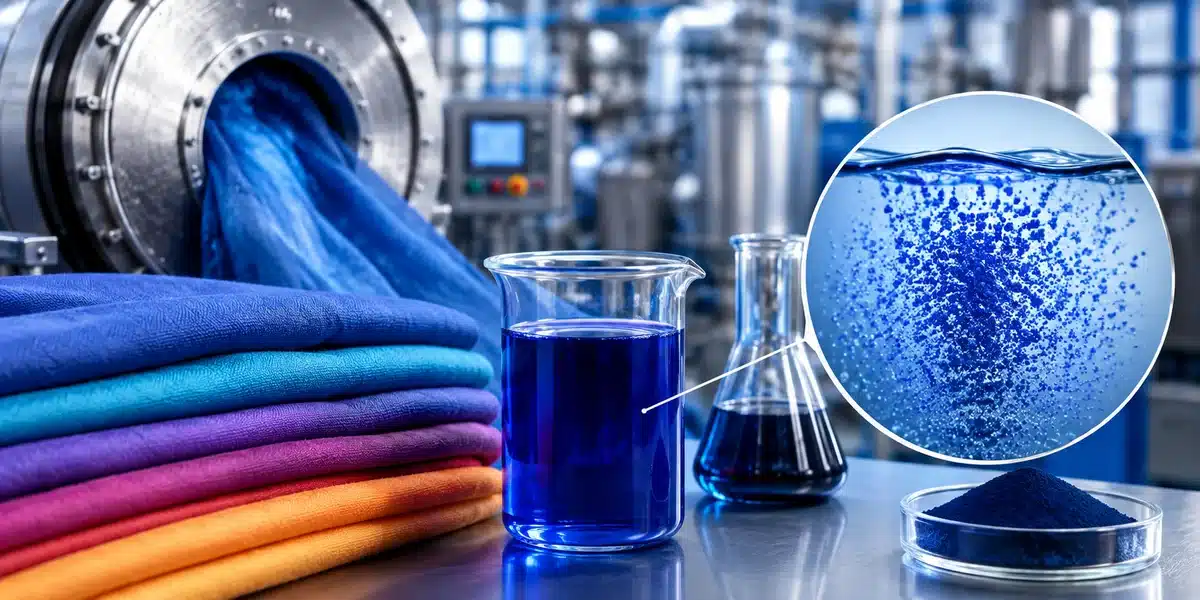
It is common to understand the importance of a dispersing agent if pigment settlement or uneven dyeing due to dye agglomeration is experienced. A dispersing agent is an auxiliary agent that can let solid particles or droplets distribute evenly in a liquid medium, thereby increasing the stability and efficiency of modern industrial production.
The working principle and selection criteria of dispersing agents would be explored by chemical buyers, formulation engineers, or technicians in the textile industry. In the following, the dispersing agent will be explained from basic concepts to actual applications.
1. What is a Dispersing Agent?
Dispersing agent is a kind of chemical substances that promote the even dispersion of solid particles or droplets in a liquid medium, and prevents them from re-aggregating.
The core functions of dispersing agent include deflocculation, which disperses the aggregated particles, and stabilization, which maintain the dispersed state. Also, it also serve the functions as sedimentation prevention that can prevent particles from settling due to gravity.
Many everyday products cannot exist without a dispersing agent. For example, a can of off-white wall paint can maintain a uniform consistency because of the dispersing agent. A dispersing agent can also make the pesticide dilute in water evenly.
2. Types of Dispersing Agents
Dispersing agent can be categorized according to their chemical structure, in which the working mechanism and scope of application are different for each type.
Anionic Dispersing Agent | It carries a negative charge, which is the most used type in the industry. The representatives are Sulfonates, Carboxylates, and Phosphates. Sodium Lignosulfonate is also an example of an anionic dispersing agent that is widely used in the textile, construction, and pesticide industries. |
Cationic Dispersing Agent | It carries a positive charge and adsorbs to the surface of negatively charged particles by static electricity. It is commonly seen in certain coatings and mining applications, but the scope of use is narrow because of the high cost. |
Non-ionic Dispersing Agent | It is electrically neutral and mainly works through steric hindrance. Polyethylene glycol (PEG) is one of the examples. It maintains stability in conditions of high electrolyte concentration and is not affected by pH value, which makes it commonly used in dye and pesticide. |
Polymeric Dispersing Agent | Its properties of large molecular weight, electrostatic repulsion, and steric hindrance provide a long-lasting effect. Polyacrylates is the most common polymeric dispersing agent, which are widely used in high-performance concrete and ceramics. |
3. How Does a Dispersing Agent Work?

The working principle of a dispersing agent can be understood using a simple analogy. A group of people will push and gather together if they are packed into a small space. Dispersing agent functions like putting on a spiked coat for everyone, that makes people from getting close to each other and results in dispersion evenly.
From the aspect of chemistry, a dispersing agent has an amphiphilic structure that is hydrophilic on one end and lipophilic on the other end. The lipophilic end absorbs onto the surface of the particle, while the hydrophilic end extends into the liquid medium , and a protective layer is formed.
There are two types of stabilization mechanisms.
● Electrostatic Repulsion: Anionic dispersing agent ionizes in water, and the surface of particles becomes negatively charged. Particles with the same charge repel each other and prevent aggregation.
● Steric Hindrance: Polymeric dispersing agent forms a physical barrier on the surface of particles, which prevents particles from approaching each other even though the electrostatic repulsion is not strong enough.
These two stabilization mechanisms were utilized by a high-performance dispersing agent because more long-lasting and stable effects can result.
4. Common Chemicals Used as Dispersing Agents
There is a wide variety of dispersant chemicals on the market. Here are some of the most important:
Sodium Lignosulfonate | It is the by-products of the paper industry, which is the most used natural dispersing agent globally. With the low cost ($50 per ton) and the high water solubility, it is widely used in the concrete, textile dyeing, pesticide, and mining industries. The downside is that the color is relatively dark (brownish), which make it not suitable for applications that require specific color matching. |
Sodium Methylene Bis Naphthalene Sulfonate (NNO) | It is a synthetic anionic dispersing agent that is resistant to high temperature, acid, and alkali. It is one of the most important dispersing agents in the textile dyeing industry, as it is suitable for grinding and application of disperse dyes and vat dyes. The cost of NNO is higher than that of Sodium Lignosulfonate, but the performance of NNO is more stable at high temperatures. |
Polycarboxylate | It is a polymeric dispersing agent with a high molecular weight. The efficiency is the highest, and therefore, it is the mainstream choice of high-performance concrete water-reducing agent. The cost of Polycarboxylate is 5-10 times that of Sodium Lignosulfonate, but the dispersion effect is far better than that of traditional dispersing agents. |
Sodium Polyacrylate | It is widely used in the ceramics, papermaking, and water treatment industries. It is the standard ceramic dispersing agent as it works best in slightly alkaline conditions. |
Sodium Tripolyphosphate (STPP) | It is an inorganic dispersing agent with a very low cost. It is commonly used in detergents and ceramic formulations. However, its use is restricted in the EU and other regions because of the eutrophication of water bodies by phosphates. |
5. Applications of Dispersing Agents in Industry

Dispersing agent is applied across all manufacturing industries.
Construction Industry | Dispersing agents can reduce the water consumption by 12-30% in concrete formula, and increase the strength and flowability of concrete. The traditional choice is Sodium Lignosulfonate, while Polycarboxylate is a high-end choice, with the annual consumption of millions of tons globally. |
Textile Dyeing Industry | Disperse dyes are insoluble in water. They rely on a dispersing agent to grind the particles of dyes and make them disperse steadily, and evenly dye synthetic fibers such as polyester. Sodium Lignosulfonate and NNO are two common dispersing agents in the textile dyeing industry. |
Pesticide Industry | The active ingredients of insecticides and herbicides are water-insoluble. Dispersing agents can turn them to Wettable Powder (WP) or Suspension Concentrate (SC), which can by sprayed on crops evenly after dilution in water. The effectiveness and stability of pesticide are depends on the choice of dispersing agents. |
Coatings and Ink Industry | Dispersing agents are the essential components of coatings because pigment particles are prone to aggregation. The dispersing agents help to break down pigment aggregation so that the colour can be more brilliant and even. They can also prevent pigment settling in long-term storage. |
Mining and Drilling Industry | Dispersing agents can prevent the expansion and aggregation of clay in the oil drilling fluid, which maintains the stable rheology of the drilling fluid. Dispersing agents can also produce concentrated coal-water slurry or mineral slurry from mineral powder in mineral powder processing, which makes the transportation more convenient. |
Battery Industry | In the production of lithium battery, dispersing agents help to distribute carbon black and graphite into the slurry, which affects the battery energy density and the cycle life directly. |
6. Natural vs Synthetic Dispersing Agents
Dispersing Agents are divided to natural and synthetic one in the market, with each of them having its advantages and disadvantages.
Natural dispersing agent, such as Lignosulfonate | |
Advantages | Renewable source |
Biodegradable | |
Low cost | |
Disadvantages | Dark color (brown to black) |
Batch-to-batch variations in quality | |
Limited performance in extreme temperature and pH conditions | |
Synthetic dispersing agent, such as NNO, Polycarboxylate | |
Advantages | Stable performance |
High efficiency | |
Precise control according to requirements | |
Disadvantages | High cost |
Poor biodegradability in certain synthetic dispersing agents, such as Naphthalenesulfonate | |
The demand for green dispersing agents is growing rapidly, as the REACH regulation in the EU has restricted the use of several synthetic dispersing agents. Lignin-based dispersing agents are receiving increasing attention because of their renewability and low toxicity.
7. Advantages of Lignin.Based Dispersing Agents
Lignin-Based Dispersing Agents are the most widely used natural dispersing agents, with the main form being Lignosulfonate. The advantages include:
● Cost: As the byproduct of wastewater from the paper industry, Lignosulfonates cost $50-150 per ton. It is one-third to one-tenth the price of most synthetic dispersing agents, which provide a great cost advantage in high-volume applications such as concrete additives.
● Environmental Benefits: With the property of being naturally sourced and biodegradable, each ton of Lignosulfonate used in place of petroleum-based alternatives can reduce 1.5 tons of carbon dioxide emissions. It is beneficial to export goods as it complies with the EU REACH and the US EPA environmental regulations.
● Multi-purpose: Lignosulfonate possesses the functions of dispersion, adhesion, and emulsification. It results in formula simplification as it meets multiple requirements. For example, it serves as a water-reducing agent and a retarder in concrete mix.
● Stability: Lignin-based dispersing agents can work efficiently in a wide pH range (4-13) and temperature conditions. They maintain good dispersibility even in high-temperature dye bath conditions of textile dyeing.
8. How to Choose the Right Dispersing Agent

The choice of dispersing agent is decided by multiple factors, without a standard answer.
Main consideration: dispersion medium and particle properties | A completely different dispersing agent is required in water-based and solvent-based systems. The choice is decided by the surface charge, size, and concentration of particles. Generally, anionic dispersing agents should be chosen for negatively charged particles, while cationic dispersing agents should be chosen for positively charged particles. |
pH and temperature conditions | The performance of the dispersing agent is different in different pH and temperature conditions. Lignosulfonate can work in the range of pH 4-13, but the performance declines in highly acidic conditions. NNO performs steadily in high temperature and strong alkaline conditions, while Polycarboxylate works best in alkaline conditions. |
Environmental protection and regulatory requirements | Some Naphthalenesulfonate dispersing agents are restricted for export to the EU because of the REACH regulations. Natural dispersing agent is the only choice in certified organic pesticides. Therefore, biodegradability is a more and more important factor in choosing the right dispersing agent. |
The balance between performance and cost | Lignosulfonate is an adequate choice for general application. However, a dispersing agent with high performance should be chosen in high-performance concrete, high-precision printing, or high-end coating, which may be more cost-effective in the overall production cost. |
It is recommended to ask for a technical data sheet (TDS) and a sample from the suppliers and conduct small-batch trials before mass production, as the same dispersing agent may perform differently from different suppliers.